

This is a clip of Carl Sagan’s final speech from the 1980 Emmy award winning PBS television series Cosmos, which has been broadcast in more than 60 countries and viewed by over 500-million people. Are you one of those people? If not, better late than never. Sagan’s farewell discusses science,
hite
- November 11, 2022

This is a visualization imagining you’re a beam of light departing New York City, traveling the circumference of the Earth, and returning to New York City. How long does it take? Well since the speed of light is approximately 300,000km/s and the Earth is about 40,075km in circumference, it takes
- November 1, 2022

This is a video of a crab man at what I assume is a swingers resort demonstrating the incredible power of refraction, with his body seemingly completely disconnected from his head in a curved glass (read: acrylic) walled pool. Physics! Still, as wild as this is, I imagine even crazier
- October 10, 2022
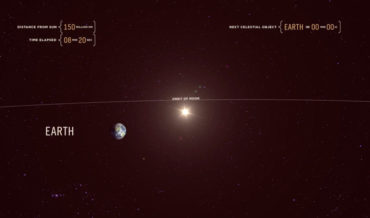
This is a visualization imagining you’re a beam of light leaving the sun and traveling out of our solar system at the speed of light. I mean what other speed would you be traveling, you are a beam of light after all. And I mean that too — you’re a
- October 1, 2022

This is a 10-hour video of Jupiter rotating in real time, completing one full revolution in the process. Now don’t expect a tilt-a-whirl here, it takes ten hours to complete one rotation, so it’s slow to the naked eye. But to the eyes wearing a sexy lace thong like mine
- September 8, 2022

This is a video of the Slow-Mo Guys filling up two Stretch Armstrong dolls with water from a garden hose until they explode. They do one just laying in the grass, and another while Dan lovingly embracing the doll. Haha — not so tough now, are you, Mr. Armstrong?! God,
- September 2, 2022

How much stronger does duct tape make everyday objects? INFINITELY. And to test the tape’s strength-adding properties, the fun-loving Youtubers behind the Hydraulic Press Channel have created a video of everyday objects (including cans and plastic bottles, footballs, and a stack of Post-Its) getting crushed both in their natural state,
- August 24, 2022
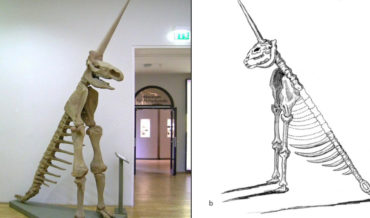
This is the ‘Magdeburg Unicorn’, a fossil reconstruction assembled a few years after the bones of a woolly rhinoceros were discovered in Germany in 1663. Allegedly the reconstruction was performed by Prussian scientist Otto von Geuricke, who, I think we can all agree, did a stellar job. I wish I
- August 23, 2022